
Adobe Q2 FY26 Earnings Review: AI, Freemium and the Margin Question
Adobe’s Q2 numbers were strong, with revenue, ARR and free cash flow still growing. But investors are now focused on the bigger question

Software businesses are going through a lot of changes, both from inside and outside.
Their business model is changing. The way they operate is changing. The way customers need them, use them, and pay for them is also changing.
Customers now have more options in SaaS than ever before. They demand more from their tools. They do not just want software that stores information or helps them complete a task. They want tools that help them achieve an outcome.
This puts a lot of pressure on SaaS companies, including Adobe.
Before going into the numbers, I want to share my opinion about this transition, both the good and the bad, especially for Adobe.
The market mostly does not agree with Adobe right now, or at least it does not have much patience. Even the CFO leaving, after around four years at Adobe, was enough to make the market sell off again.
I wrote about Adobe in detail a few weeks ago, so you can find more about the business there.
Adobe: The Stock Is Cheap, But the Business Is Changing

At its peak in November 2021, Adobe was worth about $328 billion in the market.
Investors are looking at every signal negatively. Why is the CFO leaving? Why is the CEO leaving? Who will guide this company during this important transition period? Why are insiders not buying stock? Why is there no clear insider ownership signal?
Even for the quarter specifically, I think the stock sold off after earnings for four reasons.
Adobe effectively told investors that near-term ARR will be lower than it otherwise could have been. Part of this is because the company is choosing to push freemium growth, and part of it is because Adobe is delaying some planned Creative Cloud line optimisations. So Adobe is choosing more users and lower friction today over faster monetisation today, and the market does not like it because it creates a gap between usage and revenue.
Wall Street wants quick proof. But this freemium strategy will take time to prove itself. Management is basically asking investors to wait and see whether these free users convert into paying customers over the next few years.
Adobe has to spend more on compute, product development, sales and marketing to defend its position and build new AI-native products. That may be necessary, but it also puts pressure on short-term margins. AI can increase usage, but if that usage costs more and customers do not pay enough for it, the economics can become worse, not better.
This transition is happening at a sensitive time. Adobe already has a CEO transition on the table and now CFO leaving.
When sentiment is bad, people stop looking at the business rationally. They focus only on the negative signals and forget to analyse both sides.
And we need to analyse both good and bad for the business. The good side is that companies like Adobe have more than 20 years of experience, customer data, workflows, product knowledge, and domain expertise. AI is very powerful, but AI still needs direction. It needs clean data, clear workflows, rules, context, and protection from mistakes.
Powerful tools like ChatGPT, Claude, Gemini or other AI models can create a lot of value. But for enterprise customers and professional creators, that is not enough. These models still need to be put inside the right workflow. They need rules, brand context, permissions, history, compliance, and guardrails.
Adobe can give AI direction. It can connect AI to real creative workflows, protect customers and help companies create content in a more brand-safe and structured way.
Creativity is a very specific field. Even if hyperscalers and AI labs have great models, they still need domain experts like Adobe to deliver these solutions properly to end users and enterprises.
And when we look at the numbers, AI has not destroyed Adobe’s business but It has created uncertainty. It has changed payment models. It has created pressure on margins and monetisation.
Adobe reported $6.62 billion of revenue, up 13% year over year. Subscription revenue reached $6.42 billion. Total Customer Group subscription revenue was $6.39 billion, up 14%, including about $40 million from Semrush.
Business Professionals & Consumers grew 16% to $1.85 billion, while Creative & Marketing Professionals grew 13% to $4.54 billion.
The core subscription engine is still growing. Profitability also remained very high, although it did not expand.
GAAP operating income was $2.24 billion, 34% of revenue. Non-GAAP operating income was $2.95 billion, 45% of revenue. That is still excellent software profitability,
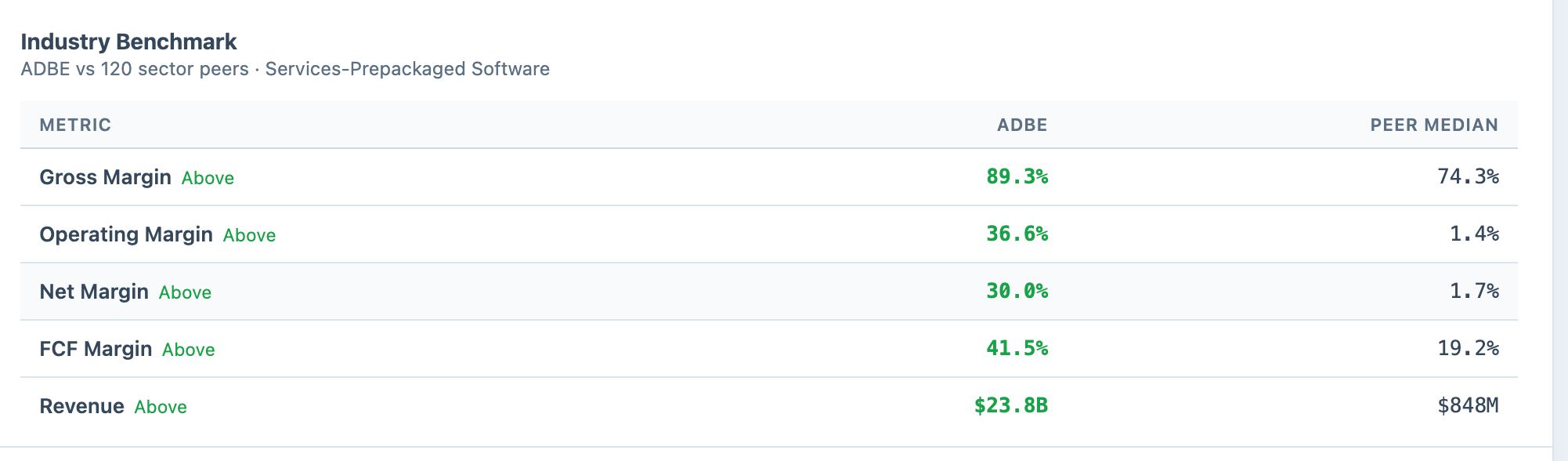
Adobe generated $2.17 billion of operating cash flow and spent only $58 million on CAPEX leaving about $2.11 billion of simple free cash flow.
Adobe repurchased about 8.5 million shares during the quarter, and the cash flow statement shows $2.11 billion used for buybacks. Diluted shares fell to 402 million, down from 429 million a year ago.
The trade-off is that Adobe also closed the Semrush acquisition, spent $1.56 billion on acquisitions net of cash acquired, and ended Q2 with about $5.63 billion of cash and short-term investments against about $6.65 billion of debt.
Disclaimer: This article is for informational purposes only. It is not financial advice. I am not a financial advisor. I may buy or sell these stocks at any time. You must do your own research before investing
By reading this email, you agree to the full disclaimer found here: https://www.thevaluethesis.com/p/disclamier
